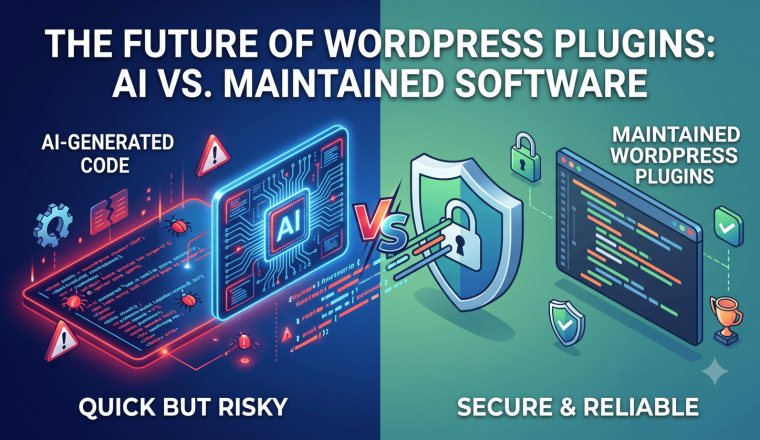
Are WordPress Plugins Dead? AI and the Future of WordPress Plugins

Take a look at any developer community or Facebook group today, and you will see a common panic about the future of WordPress plugins. Sales for simple plugins are dropping. People are using tools like Claude and ChatGPT to write their own code. Tech savvy clients are moving to Next.js.
Many people are asking if WordPress plugins are dead, heavily debating the future of WordPress plugins. As someone who has studied AI and its impact on the tech industry for years, I can tell you exactly what is happening. We are going through a massive shift. AI is definitely changing how we build websites. But the idea that AI will completely replace the need for professional, well maintained WordPress plugins is completely wrong.
Let us look at the reality of building and maintaining a website today. Let’s see why relying only on AI for your website features can actually turn into a nightmare in the long run.
The Real Cost of “Free” AI Code
If you need a simple pricing table or a basic announcement bar, you can ask an AI to write the code. Within seconds, you have a working script. For a frontend developer, this feels like magic. They no longer have to hire someone else to write basic PHP or JavaScript.
Because of this, many people doubt the future of WordPress plugins and assume there is no reason to buy them anymore. But they are missing a huge part of the picture. Writing the code is only ten percent of software development. The other ninety percent is maintenance, security, marketing and compatibility.
When you generate a custom script with AI and paste it into your website, you become the sole maintainer of that code. If you are a developer, maybe you can handle that. But if you are a normal business owner or a non technical user, you just set a ticking time bomb inside your website.
Why You Should Buy From a Reputable Company Instead of Using AI
There is a big difference between a piece of code and a software product. When you buy a well maintained WordPress plugin from a dedicated company, you are not just buying the initial code. You are buying a service.
Ongoing Compatibility
WordPress updates its core software several times a year. PHP gets updated. Themes change their architecture. A premium plugin company has a whole team testing their product against these new updates before they are even released to the public. If something breaks, they fix it immediately. An AI will not send you an email warning you that your custom script will break in the next WordPress update.
Customer Support
When things go wrong on a website, they usually go wrong at the worst possible time. If a premium plugin conflicts with your theme, you open a support ticket. A human expert logs in, finds the issue, and gives you a fix. If your AI generated custom code breaks your site, you are completely on your own. You have to figure out how to debug a white screen of death, which is impossible for a non coder.
Trust and Accountability
A reputable company has a reputation to protect. They follow strict coding standards because their business depends on it. An AI does not care if your website goes down. It just outputs the text you asked for based on the prompt you gave it.
Custom Coding vs Plugins: Navigating the Future of WordPress Plugins
Using AI to generate custom code instead of installing a dedicated plugin sounds like a smart way to save money. But if you look at the actual daily challenges of running a website, the true future of WordPress plugins becomes clear: dedicated plugins are still the better choice.
The Maintenance Nightmare for Non Coders
Imagine a small business owner who uses AI to build a custom plugin for a team showcase. It works perfectly on day one. Six months later, their hosting provider upgrades the server to a new PHP version. Suddenly, the website crashes.
The business owner has no idea what went wrong. They do not know how to read server error logs. They try to ask the AI for help, but they do not know what error to paste into the chat. What started as a free solution now requires them to hire an expensive developer just to bring the site back online.
A premium plugin avoids all of this. The plugin developer would have released an update months ago to ensure compatibility with the new PHP version. The user just has to click the update button.
The Hidden Financial Trap: Re-hiring Developers vs. Plugin Subscriptions
Consider the long term financial math. Suppose a business owner hires a developer to build a custom feature using AI. They pay an upfront cost for the initial build. Three to six months down the line, a major WordPress, PHP, or browser update causes a code conflict.
Can a non technical client open ChatGPT and fix the bug themselves? Realistically, no. They do not know how to inspect console errors, read server logs, or identify which exact line of code broke.
This creates a hidden financial trap. Every time something breaks, the client must contact a developer, wait for their availability, and pay an hourly rate just to debug and patch the issue. If updates break the code two or three times a year, the client ends up paying recurring developer fees endlessly.
Compare this to buying a professional plugin. Even with an annual subscription fee, or a one-time lifetime license with ongoing updates, the cost is a fraction of what you would pay a developer for an hour of troubleshooting. With a commercial plugin, the maintenance cost is shared across thousands of users, giving you automated updates, instant bug fixes, and continuous peace of mind without unexpected maintenance bills.
Time Wasting for Developers
You might think developers would completely abandon plugins since they can just use AI. But real world experience shows something different. Developers value their time.
Yes, a developer can ask AI to build a custom popup feature. But then they have to test it across different browsers. They have to make sure it is fully responsive. The code must also integrate perfectly with the global styling of the specific WordPress theme. On top of that, building a settings panel is required if the client wants to change the popup text later.
Doing all of this takes hours. Even with AI, integrating and testing custom code is a slow process. A smart developer knows that buying a fifty dollar plugin that already has a settings panel, responsive layouts, and tested integrations is a much better use of their time. Rebuilding things from scratch every time is bad for business.
The Hidden Security Risks and Performance Issues
This is the most dangerous part of relying entirely on AI. AI is incredibly smart, but it lacks context. If you do not give an AI strict, detailed instructions about security protocols, it will often skip them to give you a faster result.
WordPress has very specific security standards. Things like data sanitization and nonce verification are required to keep hackers out. AI often writes functional code that completely ignores these security standards. This leaves huge loopholes in your website. Hackers run automated bots 24 hours a day looking for these exact vulnerabilities.
There is also the issue of performance. A developer in a Facebook group recently shared a perfect example. A user had an AI write a custom plugin. The code worked, but the AI wrote a database query that searched the entire database hundreds of times per second. The website owner did not notice until the end of the month when their cloud hosting provider sent them a massive bill for excessive read and write requests.
A human developer or a professional plugin company knows how to optimize server requests. They build sustainable architecture. A simple AI prompt often results in heavy, unoptimized code that can ruin your server performance.
Will WordPress Survive the Next.js Trend?
There is a lot of talk about tech savvy clients moving away from WordPress entirely to use modern stacks like Next.js. It is true that for highly complex, scalable web applications, modern frameworks are becoming the standard.
But we have to look at the whole market. The vast majority of website owners are not tech savvy. They do not want to deal with complex deployments. They want a dashboard where they can easily write a blog post, upload an image, and manage their store. WordPress provides a ready made ecosystem that is incredibly easy for normal people to use.
The market will likely split into two segments.
- The highly technical users will move to custom frameworks.
- But the millions of normal business owners will stay with WordPress because they want a visual interface and a plug and play experience.
Frequently Asked Questions (FAQs) About the Future of WordPress Plugins
Future of WordPress Plugins
Yes, you can. For very simple tasks that do not handle sensitive data, AI is a great tool. However, you must be prepared to maintain that code yourself whenever your theme or WordPress core updates.
Yes, the market for extremely simple plugins is shrinking. Individual developers need to focus on creating complex, large scale solutions that solve serious business problems. Small, basic features can be generated by AI. To survive the future of WordPress plugins, developers must offer something AI cannot easily replicate, like deep integrations and dedicated support.
Not automatically. AI writes code to solve the prompt you give it. If you do not explicitly command the AI to follow WordPress security guidelines for sanitization and escaping, it will likely provide unsecured code. This makes your site vulnerable to attacks.
The internet is not a static place. Browsers update, server technologies evolve, and hackers invent new methods of attack every single day. Code that is secure and functional today might be broken and dangerous next year. Maintenance is what keeps a website alive.
The Final Verdict
The rise of AI is definitely shaking up the industry and shaping the future of WordPress plugins. It is scaring a lot of developers and changing how we think about writing code. But the fear that WordPress plugins will disappear completely is not based on reality.
AI is a fantastic tool for generating quick solutions, but it cannot replace a well-maintained software product. When you use AI generated custom code, you take on the heavy burden of security, optimization, and long term maintenance. For most website owners, this is a terrible idea that will end in broken websites and high developer fees.
Professional WordPress plugins survive because they offer peace of mind. They offer regular security patches, continuous compatibility updates, and human support. Since online security threats change every day, relying on a well-maintained plugin isn’t just about saving time. It is the smartest and safest business decision you can make.



There are no comments yet for this post